

SKE 1500VA/900W Small UPS Battery Backup & Surge Protector for Computer UPS Uninterruptible Power Supply Phoenix VL1500
$179.99
Related Products


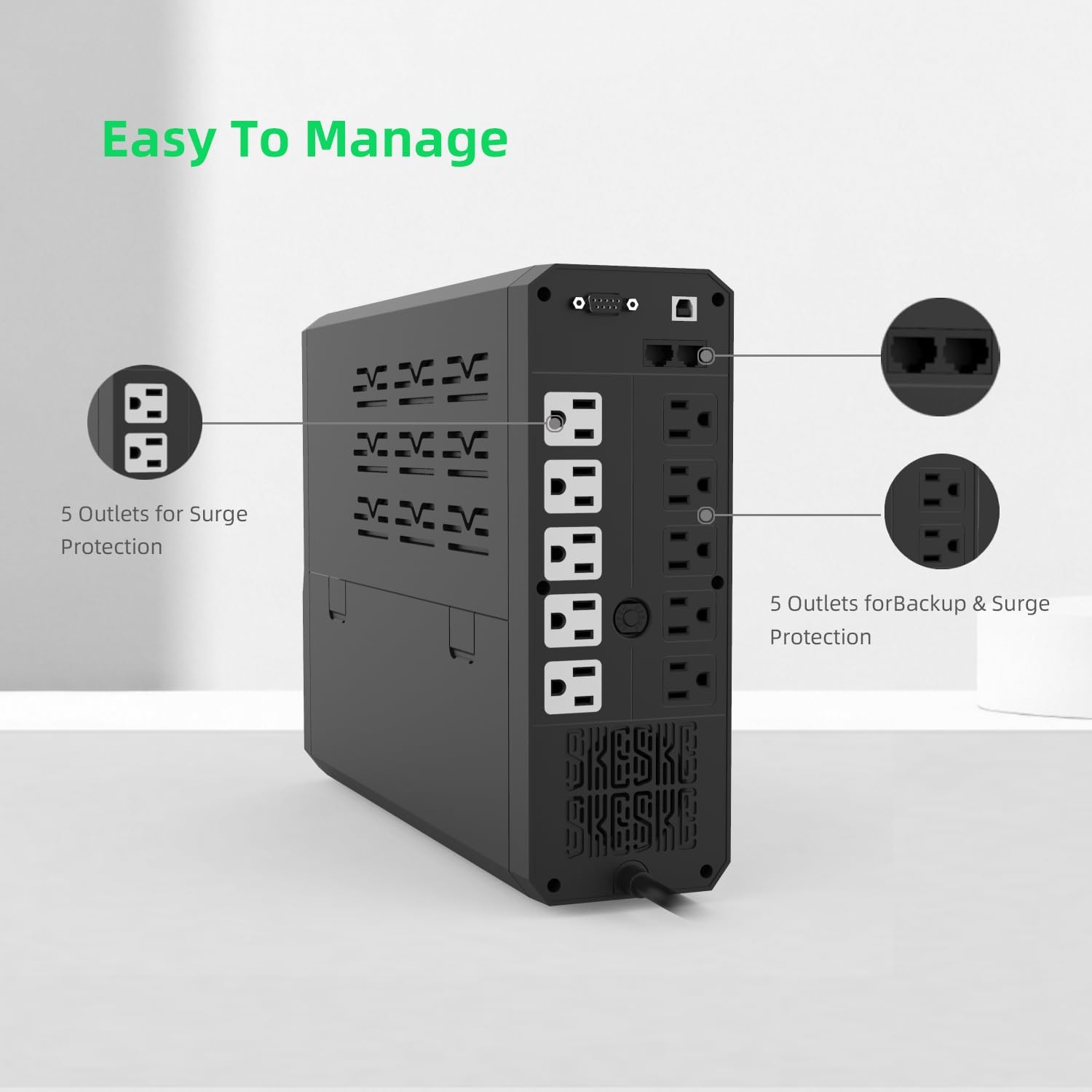
Automatic Voltage Regulation: Simulated sine wave current provides stable and clean power, protecting your network systems from surges and extending the lifespan of your devices. Unique Design: Compact size fits any space and can be placed vertically or horizontally.
10 Outlets: 5 black outlets for backup & surge protector, 5 white outlets for surge protection only. Backup your computer, router, modem, and other network devices.
Additional Ports: RJ45 port for surge protection, 2 USB outlets, and 1 Type-C outlet for fast charging your phone, laptop, and more.
Automatic Voltage Regulation: Simulated sine wave current provides stable and clean power, protecting your network systems from surges and extending the lifespan of your devices.
Unique Design: Compact size fits any space and can be placed vertically or horizontally.
Replaceable Battery: User-friendly design allows for easy battery replacement with just a Phillips screwdriver.
3 reviews for SKE 1500VA/900W Small UPS Battery Backup & Surge Protector for Computer UPS Uninterruptible Power Supply Phoenix VL1500
Add a review

$179.99
dan –
Relatively High Capacity Well-Made UPS, Abundant Outlets, Easy to Read Display, and Large Battery
I used this out of the box, as is, to provide backup power for my largish Intel ATX office computer (with i9-10900 and 8 drives). As other reviewers have mentioned, the instructions that come with this are practically inscrutable, but for my application there was nothing to be adjust- it just worked.This is a heavy power supply with a large lead-acid battery inside. During the several months I have had this, there has been one 25 minute power outage, which this UPS handily power the computer through. without shutting down (but the computer was not being used and my two large monitors were not being powered by its battery). It beeps when the wall power is down and battery power is being used, as it should- and has controls to stop the noise if wanted.As other reviewers have remarked, the output waveform is not exactly perfectfly sinusoidal, but my computers, moitors, some fluorescent desk lights, a soldering gun and other things around the office I tried ran fine on the UPS outlets.This supply has an abundance of battery powered and ordinary surge protected outlets as are shown on the product page. Its power and other switches are easy to access, and it is easy to see the electrical power status on its colorful display.I like it.
Shawn R. –
High output, tons of features, a solid choice for most. Simulated sine wave, not pure sine wave.
A few years ago I experienced a lightning strike at my office. I was at work and using my computer when it happened. There was a giant explosion sound and immediate darkness. My computer was still running because it was connected to a UPS. The lightning strike destroyed the phone system and virtually every device that was not behind a UPS. From that day on, I have been a true believer.I historically have only purchased brands I recognized like Tripp-Lite, APC and some others. Last year I bought a small SKE 425VA UPS to connect my home internet modem and router to. I got tired of everything having to reboot and reconnect everytime the electricity blinked which was occurring more frequently at my new house than it did at my old one. The SKE performed perfectly. I needed a larger UPS for a computer and found this one. Since I had good luck with the smaller one from SKE I decided to try it. It is less expensive than the similar APC brand with pretty much identical specs. When I got it, I wanted to see what the output wave looked like on an oscilloscope. I hooked it up and got my first look at a “simulated sine wave.” That sent me down a rabbit hole to learn more about the differences and how important that might be. I discovered that my APC Back-UPS 1500 also produces that simulated sine wave. I was surprised! I expected it to be a pure sine wave output. After more research I learned that the average computer, average user probably doesn’t need a pure sine wave UPS. The exception seems to be if you are running computers with high end active-PFC PSUs. It seems it is even more important if you are running multiple computers with those PSUs. From what I have learned, not having an active-PFC PSU produces more noise transmitted back into the house current and may waste some electricity because of a lower power factor.I decided that I am not a user that needs a pure sine wave UPS and this one has all the features I need. It compares very well to the APC I am using at work and that gives me a lot of confidence in it. It is capable of automatic voltage regulation. That was important to me because I’ve seen a history of the voltage variation at my new home. It varies a LOT MORE than I expected. The unit has 5 backed up outlets plus 5 more that are just surge protected. It does not have any widely spaced plugs so if you have a the brick power supplies you need to plug in, you may want a short extension cord to help utilize all the outlets. The display is large and easy to understand. Information that is available on the display includes a graphic depiction of the battery charge state, current load, input and output frequency, load expressed as a percentage and more. The unit has user replaceable batteries for longer life of the device. It’s a good choice unless you need the actual pure sine wave output.
gleg –
Decent UPS with Abysmal UI and Instructions
For the price, this unit offers a lot of bang for your buck. 1500VA/900W is a solid capacity for a lower-midrange UPS, and it should offer enough juice to keep even a high-end workstation or gaming PC powered up (if only briefly) during a power outage. If you’re using this for less demanding equipment, such as a cable modem or network router, you can likely expect to get some significant uptime before the battery runs down.In my case, I’m using this UPS to run several resin 3d printers in my workshop. These are relatively low-power devices, with the whole farm drawing less than 500W at peak usage (and FAR less most of the time). In my brief testing, the whole farm stayed up and running for at least 20 minutes without draining the battery on the UPS, and could likely go for much longer. Since my only goal is to be able to shut the printers down gracefully in the event of an unexpected power outage, I’m more than happy with this result.For this relatively basic use case, I have no complaints with the SKE 1500VA/900W UPS. Set up requires nothing more than plugging my printers into the correct outlets, and there’s no need to really mess with the device much once everything is plugged in. While running, I noted a slight increase in energy usage (typical for any UPS) vs running the printers alone, but nothing significant. Fan noise is audible, but not intrusive. The UPS is overall quiet enough that using it in an occupied room probably wouldn’t bother most people.Unfortunately, the more advanced features of this UPS are… less than impressive. The UI is confusing and the manual is less than helpful. The instructions are relatively poorly translated, and it can hard to fully understand how to make even minor setting adjustments. While these issues don’t impact the basic functionality of the unit, you should expect some struggles if you’re planning on using this device to power a computer and want to make use of the auto shutdown software. For my part, I was unable to get this software working properly despite years of IT experience.Ultimately, I would rate this UPS between 3 and 4 stars. If you’re planning on using this as a basic battery backup, it’s a 4-star device in that it performs as expected, but not exceptionally well. On the other hand, I’d take off another star if you need to use its more advanced features. In particular, if your use case relies on using the manufacturer-provided software to shut down a workstation automatically, I suggest going with a different UPS instead.